Squares Squared; Midseason Superlatives
Week 12 ruined 4-on-4 stats; thoughts on midseason awards favorites
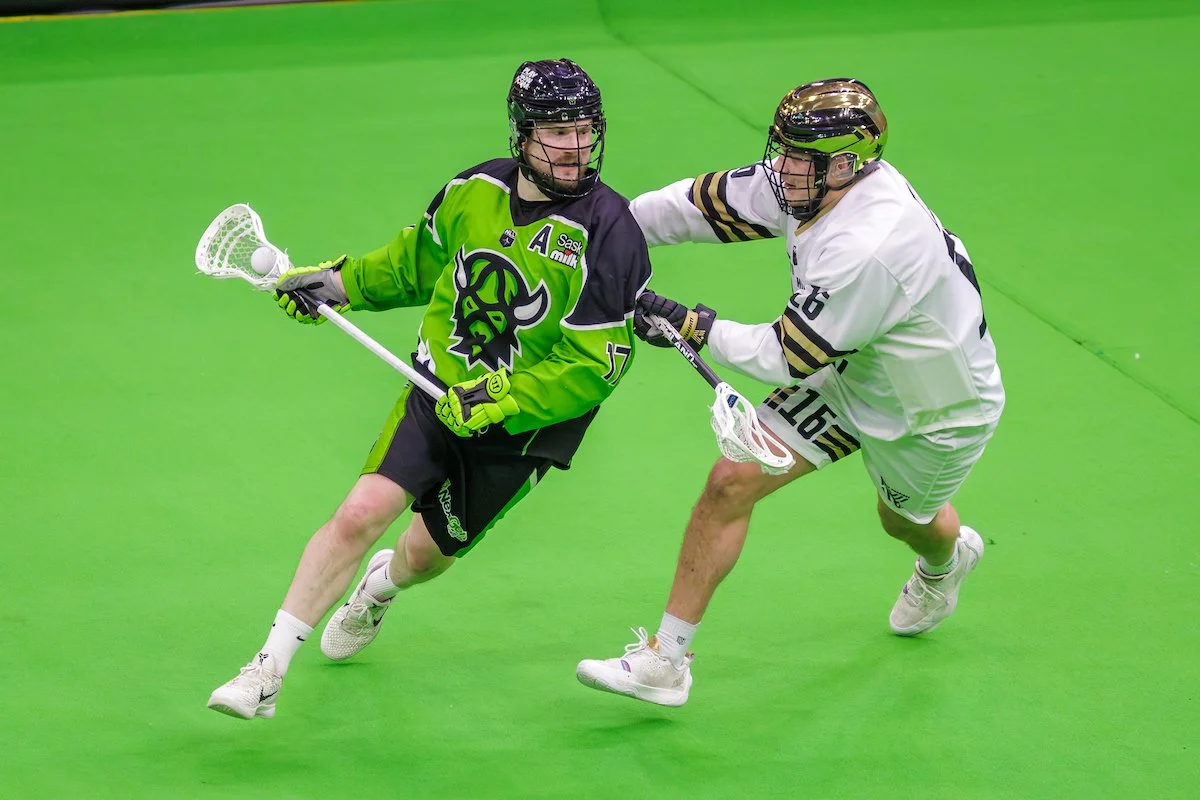
Photo Credit: Stephen Hiscock/Saskatchewan Rush
Squares Squared
The NLL implemented my favorite rule change a few years back where coincidental penalties would result in 4-on-4 lacrosse being played for the next two minutes of game time. The common refrain from broadcasters and experts was the reduction from 10 runners to 8 would result in more goals scored thanks to players having more space. Brad Challoner, Colour Broadcaster for the TSN’s Game of the Week and Vancouver Warriors home games, as well as the host of the exceptional Coaches Calls podcast, voiced that belief during a Warriors game two seasons back when a 4-on-4 situation happened.
It made me curious if that was the case, and I took that prompt to verify if it was correct or not. It wasn’t at the time — no fault of Brad or anyone else echoing the same refrain for not knowing that fact. I had just started tracking 4-on-4 with the rule change that season, and it was a bit out of sight out of mind for everyone.
In 2023-24, NLL teams had a 12.1 5ESE% and a 9.1 4ESE%. Teams were better scoring 5-on-5 than 4-on-4. More space did not mean more goals; through 135 games, it meant less.
That changed in the 2024-25 regular season. The timeworn adage proved itself true as forwards better capitalized on the extra time and room. Traditional 5-on-5 saw a 12.4 E%, but 4-on-4 was 13.4%.
Over halfway into the 2025-26 regular season, the down numbers two seasons back appear to be the exception, not the rule. NLL efficiency for 5-on-5 and 4-on-4 are 11.6% and 13.5%, respectively.
This wasn’t always the case this season, though. Through week 7, the 4-on-4 efficiency was at 9.3%, behind the 5-on-5 efficiency of 11.0%. Things started to trend upwards from there, however, with the 4-on-4 surpassing 5-on-5 efficiency in week 11, then sitting at 12.0%.
Then last weekend — week 12 — happened. And I knew while scoring the games, not paying mind to the numbers but picking up on this fact through the haze of breaking down all eight games, that an explosion of 4-on-4 scoring took place.
The numbers supporting that are above, so we won’t repeat them here, but I do want to point fingers at who took the collective 4ESG total from 19 to 25 in one weekend, a 31.6% jump. It’s all the fault of the Colorado Mammoth (against the Toronto Rock, scoring 3 4ESG and posting a slash line (S%/SOG%/E%) of 60.0/100.0/42.9), the San Diego Seals (against the Oshawa FireWolves, scoring a pair of 4ESG and a slash line of 66.7/100.0/66.7), and the Saskatchewan Rush (against the Vancouver Warriors, netting a 4ESG and a slash line of 33.3/100.0/33.3).
Six whole goals doesn’t sound that impressive considering 161 were potted in week 12, more of a firecracker than C4. But if there’s one thing lacrosse people love doing, it’s repeating the same things over and over again until they’re true. Last weekend did a lot to reinforce “4-on-4 benefits offenses cause there’s more room.”
Two things I want to end this segment on that aren’t really telling of anything but I think are fun tidbits to know and bring up in any social event you’re wanting to escape and you’re tired of your go-to “Hewwo, Pwincess”:
The most efficient 4-on-4 team this season is the Georgia Swarm, with a slash line of 30.0/90.0/25.0 and an 8.3 LP%. The worst team in this facet is a dubious honor three teams share. The Halifax Thunderbirds, Oshawa FireWolves, and Rochester Knighthawks have yet to score a 4ESG. Halifax has the best SOG% in this shift type of the three at 58.3%, but their LP% is handily the worst at 29.4%. Halifax and Oshawa being unsuccessful in an offensive category isn’t that surprising, but this dynamic (if currently slumping) Rochester offense not scoring 4-on-4 is insane. The Wings have a 4ESG, and they’ve only played 5 4ESSets. Incredibly small sample sizes all around.
Shift numbers change season to season. As an example, Buffalo’s offense had 924 5ESSets in 2023-24, 981 in 2024-25, and are on pace for 1,048 this season. But the one thing that hasn’t changed over the last two-and-a-half seasons is the percentage of total shifts 4-on-4 encompasses. Through these seasons, 4ESSets account for 1.7% of all shifts in the NLL — every season like clockwork.
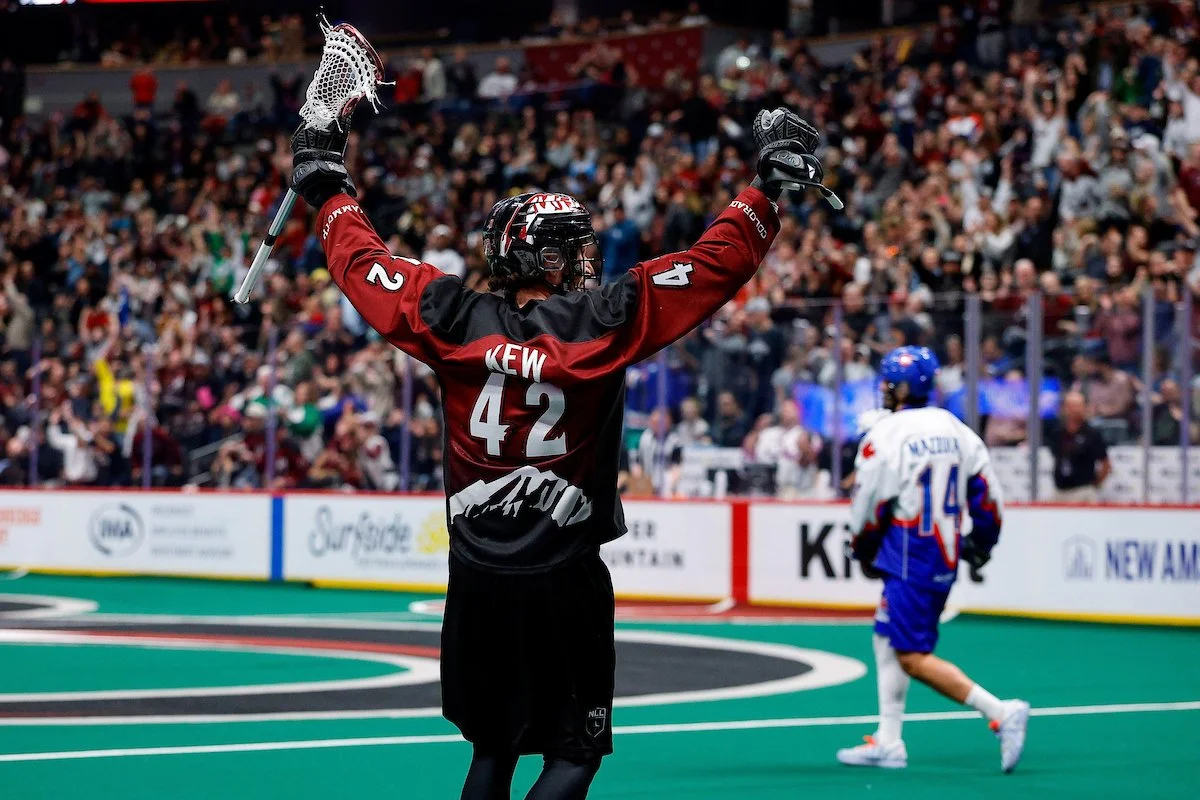
Photo Credit: Jack Dempsey/Colorado Mammoth
Midseason Superlatives
I wrote 2,000 words about how this whole engagement exercise from the NLL was handled poorly and voted on stupidly before deleting that bile-filled rant. Being raised in the South, it gets backhanded into you to not say shit if you don’t have anything nice to say — doesn’t always stop me, but it’s made me bite my tongue nearly clean off before. I try to keep my mouth shut about power rankings, broadcasts, and stupid plays, because I don’t need all that anger and disdain regularly spewing out of me, an audible firehose of filth.
I still maintain that some of you need to give your head an absolute shake, like you’re a Clancer with a gem that Ultra-InterGalactic-Cybot G Marina Liteyears is going to dislodge out of you, tears streaming down your face as you helplessly flail, but I don’t need to bitch and moan for 2,000 words about something designed to keep fans engaged in the NLL throughout the week. Ranting (deservedly) about NLL superlatives is something I did last year; stop beating dead horses, Ty, watch Gary Oldman’s Tinker, Tailor, Soldier, Spy knock-off instead (actually, I should reread Le Carre’s novels, it’s been a minute).
That said, this is an opportunity to give some shine to players and coaches I think are the frontrunners for the end of season awards. My philosophy guiding season accolades hasn’t changed from my ballot reveal last season, so I won’t repeat all of it here. I will post who I think should “win” the awards at the midway point, along with the four runner-ups in each category. This isn’t by any stretch of the imagination how I imagine things will finish at the end of the season — I’ll probably be upset again in May that Zach Currier isn’t up for MPV — just the temperature of the room currently.
Simple format: the winner is the first name, the runners up are in order in italics.
Most Valuable Player — Brett Dobson, Georgia Swarm
Jeff Teat (Ottawa Black Bears), Andrew Kew (Colorado Mammoth), Ryan Keenan (Saskatchewan Rush), Zach Currier (San Diego Seals)
It’s Dobson. Anyone telling you otherwise isn’t paying attention. His GSAA is currently higher than what Christian Del Bianco’s was when he won MVP.
Offensive Player of the Year — Jeff Teat, Ottawa Black Bears
Keegan Bal (Vancouver Warriors), Connor Fields (Rochester Knighthawks), Mitch Jones (Las Vegas Desert Dogs), Dhane Smith (Buffalo Bandits)
Stop overthinking this. Give it to the guy who scores the most and isn’t on a 2-11 team.
*Update 2026.02.20 at 10:40 a.m. — Graeme Perrow called me out on Bluesky for not considering Alex Simmons for MOP but then considering a teammate of his for the next accolade. That’s completely fair; I’m probably letting the fact I’m not a fan of Simmons’ game color that decision. Sometime I am what I rail against, unfortunately.
Defensive Player of the Year — Nick Chaykowsky, Oshawa FireWolves
Ryan Dilks (Vancouver Warriors), Callum Jones (Ottawa Black Bears), Matt Hossack (Saskatchewan Rush), Graeme Hossack (Halifax Thunderbirds)
This is a three-way race in my view. Dilks has been the best defender since the pandemic. Jones plays like a pitbull on skates, and I mean that as a compliment. Chaykowsky breaks games and has been a treat on a FireWolves team lacking things worth watching. Jones should probably earn it, but I enjoyed Chaykowsky’s most recent performance more, so he’s currently 1a.
Transition Player of the Year — Jordan MacIntosh, Georgia Swarm
Mike Messenger (Saskatchewan Rush), Zach Currier (San Diego Seals), Connor Kirst (Las Vegas Desert Dogs), Nick Weiss (Buffalo Bandits)
Bryan Cole’s playing forward, what are we doing, NLL? MacIntosh is the most effective player on the floor for the Swarm that’s not rooted to the crease. The man is having an elite season out both doors in his age-37 season. Pay attention, people, damn.
Currier’s probably going to win this at the end of the season, though. He’s been so damn good since the Seals shifted him back to playing more offense.
Goaltender of the Year — Brett Dobson, Georgia Swarm
Dillon Ward (Colorado Mammoth), Christian Del Bianco (Vancouver Warriors), Nick Damude (Philadelphia Wings), Frank Scigliano (Saskatchewan Rush)
It’s Dobson. Anyone telling you otherwise isn’t paying attention. His GSAA is currently higher than what Christian Del Bianco’s was when he won MVP.
Deja vu.
“Damude over Scigliano?!” Damude has a better GSAA and faces nearly 15 more shots on goal per game than Scigliano. The defense in front of Scigliano is way better, and while he’s been really solid this season, he’s not having near the same performance as last season when he won GotY. Stop letting the Wings being bad distract you from the reality that Damude’s playing his ass off.
Rookie of the Year — Michael Grace, Georgia Swarm
CJ Kirst (Toronto Rock), Sam English (Toronto Rock), Owen Hiltz (Toronto Rock), Nolan Byrne (Georgia Swarm)
We’re getting into races for these final spots. Right now, Rookie of the Year is race between Kirst (youngest) and Grace (of God). I’m not denying the talent that is CJ Kirst. But Grace leads the Swarm in caused turnovers, is second in loosies, scores on half the shots he takes, stays out of the penalty box, and anchors a penalty kill — as a bloody rookie. Like, c’mon, man, stop caring about points and appreciate how unbelievable the Syracuse product is.
Les Bartley (Coach of the Year) — Ed Comeau, Georgia Swarm
Pat Coyle (Colorado Mammoth), Jimmy Quinlan (Saskatchewan Rush), Curt Malawsky (Vancouver Warriors), Shawn Williams (Las Vegas Desert Dogs)
I struggled mightily picking for this. If you ask me tomorrow, I’ll probably change how I feel. What Coyle’s done with the Mammoth so far this season deserves all the praise, and I do not want to undersell that. But I didn’t think the Swarm would make the playoffs this season; they’re currently third in the standings and have the best defense in the NLL. To me, the Les Bartley Award is about exceeding expectations, not having the best team and finishing first. Comeau and Co. have done that with aplomb through ten games.
General Manager of the Year — Brad Self, Colorado Mammoth
John Arlotta (Georgia Swarm), Curt Malawsky (Vancouver Warriors), Derek Keenan (Saskatchewan Rush), Jamie Dawick (Toronto Rock)
GM, which the NLL didn’t include in this exercise for some reason, was kind of a race, but the more I think about Connor Kelly not playing for the Swarm, the more I’m inclined to give it to the guy who orchestrated the other end of that trade, Self acquiring Kew for Kelly. The defenders they drafted have been great, Braedon Saris is starting to find his game, Self acquired Jack Hannah early in the season— man’s GM-ing his ass off.
There’s a lot more Georgia Swarm in this list than I intended, but this is a special team, same as the Rush and Mammoth.
Again, this list is fluid and will probably change greatly by the end of April, but go ahead and pencil in Dobson for all the awards. It can’t be repeated enough how special and historic of a season he’s having.