I’d Like to Take His Face-Off
Thoughts on face-offs following a slow week 2 of the 2025-26 NLL regular season
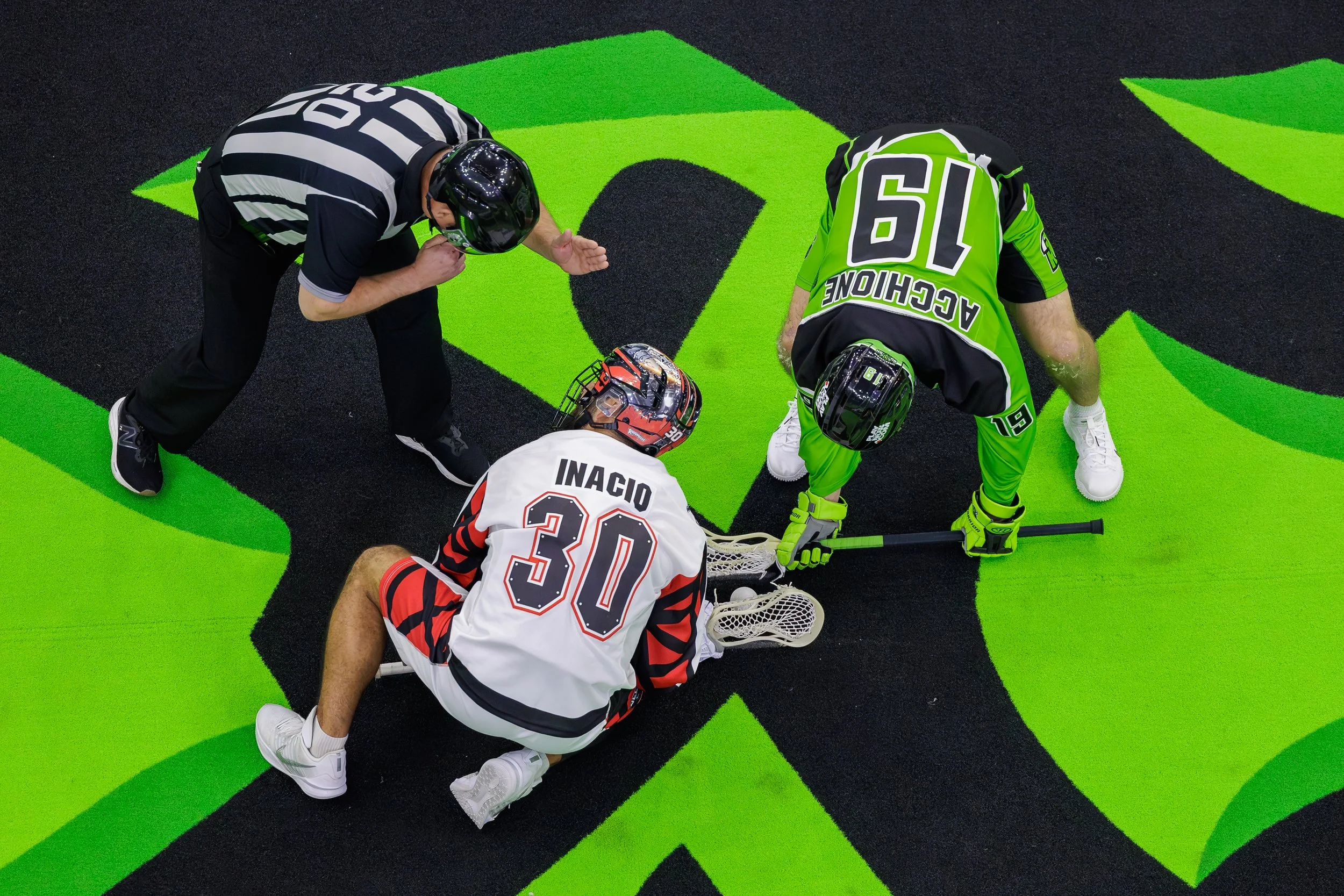
Photo Credit: Saskatchewan Rush
Let’s talk face-offs for a bit.
I don’t like them, but I think about them way more than I care to admit. It’s the worst part of an NLL game, a ceremony created so Jake Withers can embarrass whoever a team throws out to face him at the center of the turf before the Thunderbirds get possession, akin to sacrificing virgins at an erupting volcano to appease a godly entity and stay its wrath.
Part of my issue with the stat is people gave it qualities that we don’t have the data for and throw ambiguities around, like “momentum,” to back up preconceived notions about the importance of face-offs. All we’ve had are FOW, which are a footnote in a chapter of a novella that is a team’s season.
“Teams win more games with when they win more face-offs.” Not really, although that’s trending to really the past two seasons. Graeme Perrow wrote about this back in 2017 for NLLChatter.com, looking at the game data from 2010-2017 (before the 2017 postseason) and figured out teams that won the draw won 51.9% of their games. In 2023-24, it was 55.6%. Before I quit tracking it last season (so around week 11), that win percentage was 58.3%. I’d attribute that increase in FOW correlating with actual wins due to the talent of face-off specialists in the league going against less specialized players.
What we’re seeing in the NLL currently are two schools of thoughts for face-offs:
While it’d be nice to win every face-off, it’s more important to have a deeper bench for later in games.
Face-offs are important enough to win as many as possible, even if it means carrying a specialized runner who won’t play at any other time unless something’s gone wrong or we need to give Banditland what it wants, a Connor Farrell penalty shot.
Always give the people what they want.
More and more NLL teams have shifted towards the second school over the last few years with varying degrees of success. Last season, it was noticeable how many new names in the NLL were making an impact:
Mikie Sisselberger played 12 games and had 182 FOW (52.1 FOW%). Him taking over that role freed up Taylor Jensen to not have to worry about face-off duties. I spoke with Rochester head coach Mike Hasen and Jensen after their win against the Georgia Swarm in Sisselberger’s first game of the season, where we talked about the ancillary benefits of winning face-offs. (Sisselberger is currently on the Holdout List.)
Alec Stathakis played 18 games as a box neophyte, winning 261 draws for a 59.3 FOW%. Keeping the ball in the offense’s sticks meant the best defense in the NLL stayed fresher later in games. (Stahakis started the 2025-26 season on the PUP list.)
Jake Naso played 15 games and had 214 FOW and a 61.3 FOW%. His efforts helped the Rush almost hoist the NLL Cup, and him taking over draw duties meant Mike Messenger didn’t have to worry about that area of the floor. (Naso started the 2025-26 season on the Injured Reserve list.)
While not first-year players, 2024-25 was the first time Farrell (53.3 FOW%) and Justin Inacio (60.4 FOW%) played full seasons for their respective clubs, the Bandits and Roughnecks, helping contribute to their teams securing postseason berths.
It’s an incredibly small sample size, but this season, teams that win the draw game have won five of the six contests. Of the 11 teams that have stepped foot on a turf, two of them are without their main draw guy (TD Ierlan for the Rock and Joe Nardella for the FireWolves), and one features a box newbie (Matthew Paolatto for the Mammoth).
The only team to dominate draws and lose was the Calgary Roughnecks. Inacio took all 33 draws, winning 26 of them. His team started slow before making the second half of their season opener entertaining as hell, nearly pulling off the upset.
Put a pin in that Inacio bit. I’m circling back to the lack of data for face-off wins that are publicly available. Teams and certain media members can see how runners win draws cleanly or muck it up, but that information isn’t publicly available.
As part of all this stats nonsense I do, I started tracking goals scored for/against on the shift immediately following a face-off win last season. In my mind, the most important thing to do if you win a draw is to cash in on it immediately; if you lose the face-off, then either get a turnover immediately or make a defensive stop and regain possession.
In the haziness of an NLL season, I forgot to really look at what we learned from the info until now. Below is the percentage of face-offs they won/lost where they scored/allowed a goal (as a percentage — league average was 11.4%). The larger the blue and smaller the yellow for a team, the better.
Face-Off GF/GA
Percentages don’t always do a good job conveying how well a team did or didn’t do at scoring off their first post-face-off-win shift. So here’s the ratio of GF : GA, with the against implied as 1 (so Albany scored 1.14 goals off the draw for every 1 goal they let in off the draw).
| ALB | 1.14 | BUF | 1.65 | CGY | 3.31 | COL | 0.35 |
|---|---|---|---|---|---|---|---|
| GA | 0.46 | HFX | 1.77 | LV | 0.48 | OTT | 1.15 |
| PHI | 0.75 | ROC | 1.31 | SD | 0.79 | SAS | 1.61 |
| TOR | 0.56 | VAN | 1.32 |
From what we can see in the graph and ratios, certain teams were really bad not only at scoring off the draw but stopping opponents from doing it to them. Colorado, Georgia, Las Vegas, Philadelphia, San Diego (injured Trevor Baptiste), and Toronto (injured Ierlan) were lax off face-off losses and paid the price. Philadelphia and San Diego at least made their splits not as bad by seeing some success on first shifts.
Albany’s an interesting case. They were the worst at preventing opponents from scoring on face-off wins, 17.9%, but their 1.14 ratio indicates things weren’t as bad as that 17.9% makes things seem. Nardella winning 298 face-offs means there were less opportunities for opponents to score off FOW. When they did get a face-off win roughly every one out of three draws, they scored at a higher rate than others. As a comparison, Vegas gave up the most FOG of all 14 teams with 42, but because they lost 303 of them, their percentages don’t look as bad as the FireWolves’.
Unpin Inacio. The Buckeye’s dominance at the dot in 2024-25 can’t be understated, because his teammates did what they were supposed to and tickled twine on the very first possession 14.5% of the time. If he lost, the Roughnecks defense prevented opponents from scoring on that first shift the best out of any NLL team (6.6%). Scoring over three times as many FOG as your opponent throughout a season is absurd but welcome if you liked black and grey.
Of the eight teams that made the postseason in 2025, six of them scored 29 or more FOG (BUF, CGY, HFX, ROC, SAS, and VAN) and five kept opponents below the league-average conversion percentage (BUF, CGY, HFX, ROC, and SAS).
This isn’t to say conclusively that winning face-offs and scoring immediately off them means you’re winning everything. Sticking with Calgary, I’d argue acquiring Nick Rose ahead of the trade deadline and solidifying the back end was a bigger part of the team securing a postseason berth (Calgary averaged 9.86 GA/GAME with Rose and 12.73 before his acquisition), but both were parts of the same Riggers story.
The evidence has been clear for a while, though. Teams are emphasizing possessions. If you don’t have a roster spot dedicated to winning face-offs, you’re behind the times. Eventually, all teams will have their own FOGO, and the face-off playing field will be even (big “When everyone is super, no one will be” energy). Then those that have defenders that can win face-offs at high rates and play above-average defense will be unicorns dipped in gold and regarded as wizards, and that will be the new trend being chased. Defense will become the priority; face-offs will matter less.
The cycle continues; Ka is a wheel.
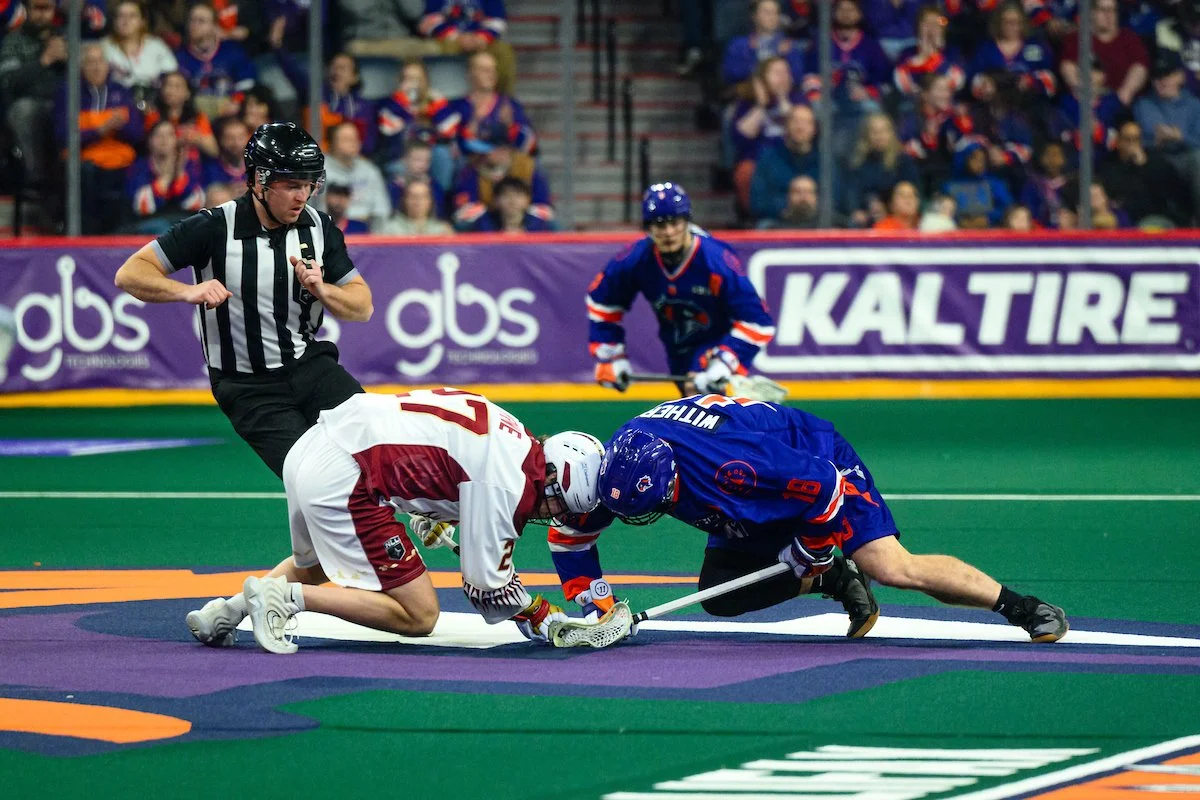
Photo Credit: T. MacMillan/Halifax Thunderbirds
If winning face-offs is so important, what is done with them becomes even more consequential. A runner who has one job has to get the ball to a free teammate and not piss away possessions or put his team on the penalty kill. From there, it’s up to his teammates to bury rubber.
The ancillary benefits for teammates relieved of draw duties is indisputable. I already talked about how Sisselberger shouldering the face-off load helped Jensen and the Knighthawks out. Naso handling those duties for the Rush meant Messenger could wreak havoc as only Mike Messenger can without having to care about face-offs (although it didn’t seem to matter too much last Saturday night). I’m high on Paolatto joining the Mammoth because it means Tim Edwards, Colorado’s main draw guy for years, doesn’t have to waste energy on face-offs and can bolster an underrated Mammoth defense even more.
If a team can deliver on more possessions and have strong defenders freed up from face-offs perform even stronger without that responsibility, then it’s the right school of thought. A FOGO who does what he’s supposed to, win and GTFO the floor without any issues, is a boon for his club.
But if your FOGO has two penalties (three, but the third was wiped out after he lost the draw to Messenger, and Messenger scored the transition goal to ice the game, wiping out that last penalty) and makes some odd (re: dumb) plays — like running into double teams to lose possession or taking an ill-advised shot after exiting the penalty box, meaning his teammates that just weathered his penalty had to go play more defense after he gave away a possession — then that’s an issue and not a sustainable contributor for a team trying to win an NLL Cup. 19 loose balls and 26 face-off wins in a game doesn’t cover up for bad decision making.
Was all of this just so I could complain about Inacio’s game on Saturday? Maybe.
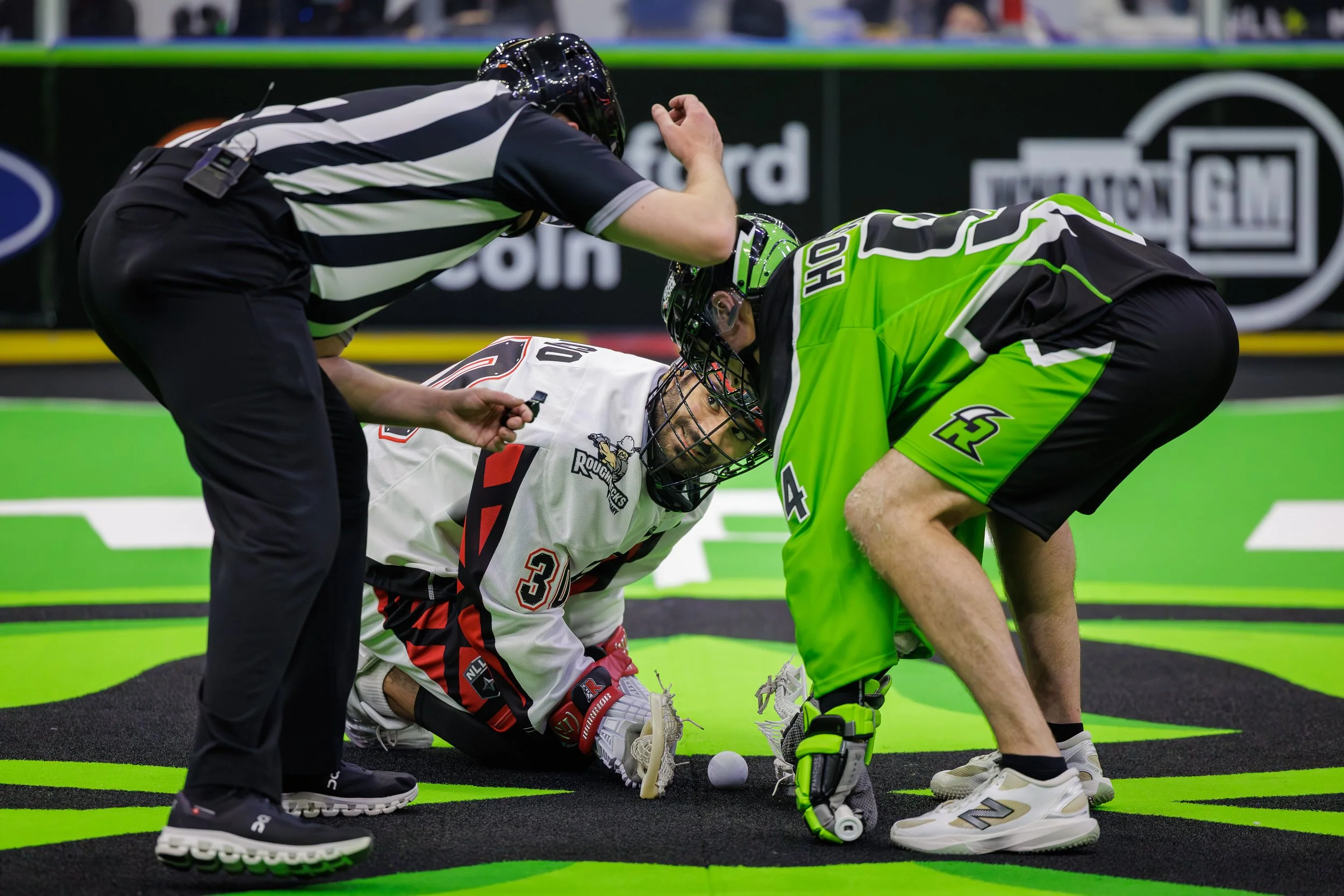
Photo Credit: Saskatchewan Rush